
The recent AEMO Quarterly Energy Dynamics Q2 2026 report[1] highlights some significant trends in how the shift to renewable energy is being made possible. In particular, it shows how much utility scale batteries have changed the market, while highlighting the need for a diverse portfolio of firming assets to ensure the system can reliably manage shocks to the system, such as wind droughts.
Australia is well progressed in its transition to a cleaner energy system and this is something the nation should be proud of. In Q2 2026, the NEM achieved just over 42 per cent renewable energy generation for the period, with a peak renewables and storage contribution of about 74 per cent[2]. This has led to an ongoing reduction in greenhouse gas emissions from the NEM, which reduced to a new Q2 low of 27 million tonnes of carbon dioxide equivalent (MtCO2-e), down 6.4 per cent from Q2 2025, with an emission intensity of 0.57 tonnes of carbon dioxide equivalent per megawatt hour (tCO2-e/MWh), down 6.0 per cent.
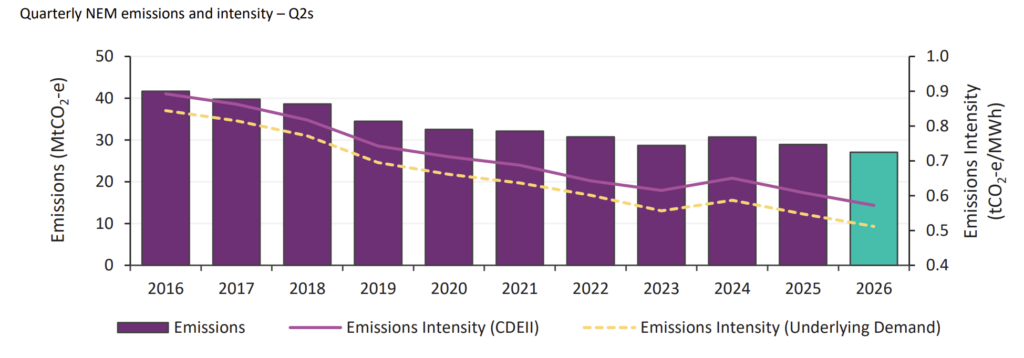
Source: AEMO, Quarterly Energy Dynamics Q2 2026, 2026; p 35
The change in generation mix was driven by strong year-on-year output growth in wind (+ 20 per cent), grid-scale solar (+12 per cent) and rooftop solar (+6.9 per cent). Coal generation fell 5 per cent for the quarter, while gas-powered generation dropped 30 per cent to its lowest Q2 average since 2003.
Figure 2: Change in NEM generation and storage by time of day – Q2 2026 vs Q2 2025
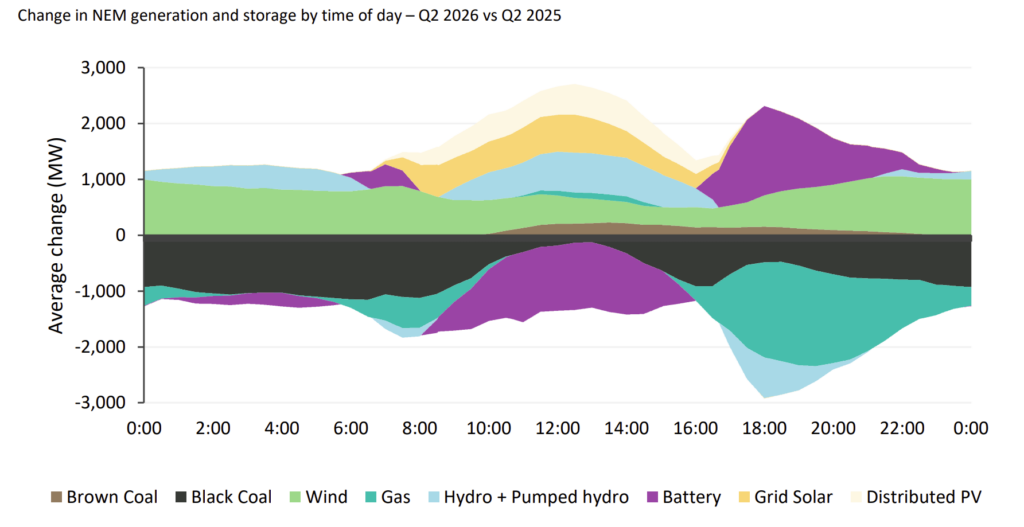
Source: AEMO, Quarterly Energy Dynamics Q2 2026, 2026; p 26
During the quarter in the NEM, 14 new generation and storage projects totalling 3.9 gigawatts (GW) were commissioned to full output, while household battery capacity grew by 3,283 megawatt hours (MWh) or 41 per cent. Grid-scale battery capacity more than doubled over the past year to exceed 9 GW.
Perhaps the headline of this quarter was the increasing role of grid-scale batteries and how this is changing the market. Battery charging and discharging set prices in 36 per cent of dispatch intervals, up from 17 per cent in Q2 2025. All mainland NEM regions recorded a greater influence of batteries on price setting, particularly New South Wales and Queensland.
Figure 3: NEM price-setting frequency and average spot price when price-setter by fuel-type – Q2 2026 vs Q2 2025
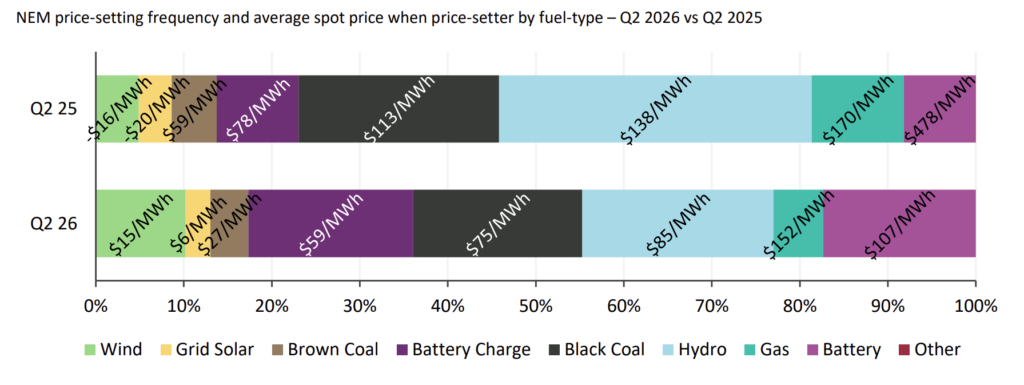
Source: AEMO, Quarterly Energy Dynamics Q2 2026, 2026; p 21
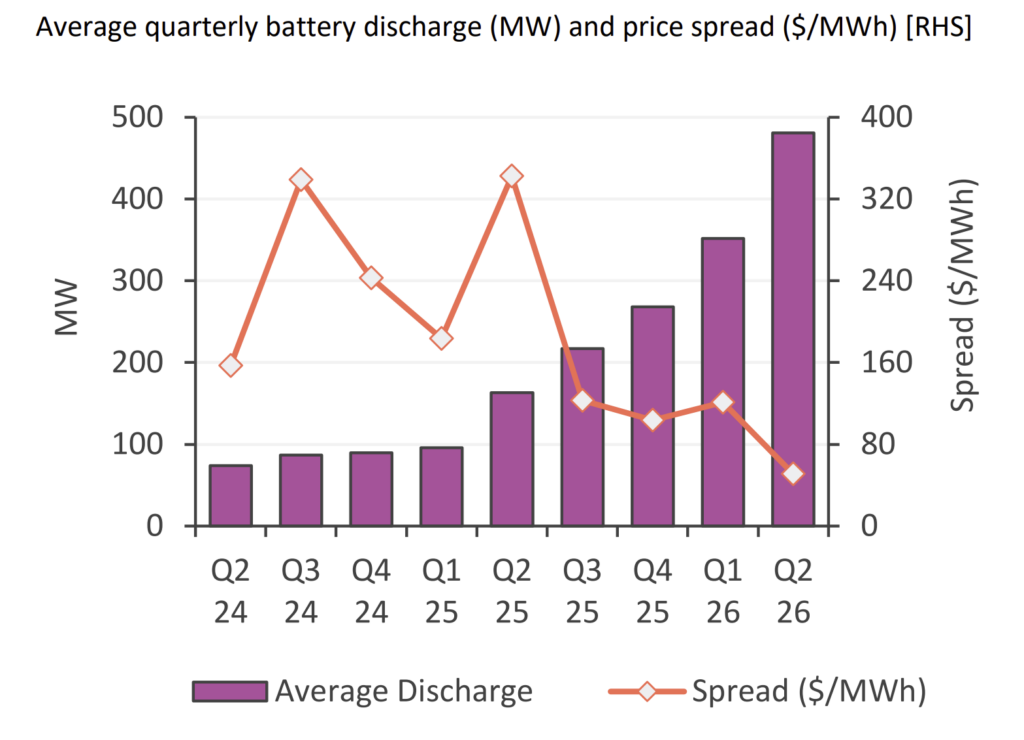
But whilst batteries are setting the price in more intervals, the average battery price spread has reduced significantly. All NEM regions experienced this decline for the quarter – with the largest decrease in New South Wales and Victoria, where spreads fell by $381/MWh (-90 per cent) to $41/MWh and by $350/MWh (-88 per cent) to $50/MWh, respectively.
Figure 4: Average quarterly battery discharge (MW) and price spread ($/MWh)
Source: AEMO, Quarterly Energy Dynamics Q2 2026, 2026; p 38
This reduction in volatility contributed to average NEM wholesale electricity prices falling 47 per cent year-on-year to $74 per MWh. Victoria recorded the largest decline, with prices falling 60 per cent to $56/MWh, followed by New South Wales (down 53 per cent to $75/MWh) and Queensland (down 44 per cent to $67/MWh).
The South Australian experience
The exception was South Australia. On 21 and 22 June 2026, cold and still conditions increased demand and reduced wind output, while transmission constraints restricted imports from neighbouring regions and increased reliance on gas-fired generation. AEMO estimates that high prices on these two days contributed $13/MWh to the region’s quarterly average price of $86/MWh.
The events of 21-22 June provide a real-world example of what can happen during a wind drought. Whilst batteries were able to provide cover for a number of hours on the evening of the first day, once discharged, high prices acted as a disincentive to them recharging. This left the state exposed as interconnector flows were also limited. The QED explains this in more detail[3]:
‘With prices remaining above $300/MWh over the evening of 21 June, South Australia’s batteries discharged nearly all of their stored energy through the evening peak (Figure 19). As the fleet’s state of charge (SOC) fell to well below 200 MWh or around 10% of storage capacity, prices spiked above $10,000/MWh for four dispatch intervals, with a further two intervals above $3,000/MWh.
Low wind output and reduced interconnector flows persisted overnight, keeping prices above $300/MWh in most intervals, including a further nine intervals above $1,000/MWh. Most batteries avoided charging at these elevated overnight prices (Figure 20), leaving South Australia’s battery fleet SOC low at around 200 MWh going into the Monday morning peak.’
A longer-term view
The 2026 Integrated System Plan (ISP) has included an important firming role for gas generation. It expects that flexible gas generation will be required to support power system reliability and security, but is used sparingly. The following statement is particularly relevant to the recent South Australian example:
“Individual plants would generate up to 10% of their annual potential, but will be critical when they run. They may be needed as back-up capacity in peak demand periods, and will be needed most on days with low renewable availability. This is more likely to be in winter, especially in the southern states, when shorter days reduce solar output, and when more electricity is needed for longer and colder nights.”[4]
Governments have recognised the need for further investment in firming assets, through policies such as the Capacity Investment Scheme (CIS), NSW Long-term Energy Service Agreement (LTESA) and the South Australia Firm Energy Reliability Mechanism (SA FERM). However, as these policies focus largely on price, they have tended to support the deployment of batteries, and have struggled to incentivise other options such as gas and pumped hydro[5]. Further, currently subdued wholesale prices and the relative lack of volatility make the investment case for new firming assets more difficult.
The recent SA FERM tender round provides an example. The policy is designed to support ‘long-duration’ dispatchable electricity capacity. However, Tender 1[6] awarded contracts to six battery projects. These are nominally four-hour batteries that will be contracted in a way that they are able to dispatch at least the committed output capacity for 8 hours during forecast Lack of Reserve (LOR) events in the nominated period.
The National Electricity Market wholesale market setting review final report[7] recommended an Electricity Services Entry Mechanism (ESEM) as its central feature for a future market. This would comprise contracts for three types of services – bulk energy, shaping and firming. These contracts are currently being considered by an industry co-design working group. The group has so far put forward a $600/MWh cap contract as the likely instrument for the firming service[8]. This may incentivise batteries but is unlikely to be enough to support investment in new gas peaking plant or pumped hydro.
The Australian Government has indicated through the NEM Reform implementation project that other policies such as a special reserve could be used to support longer duration firming services. Alternatively, it may be up to individual states to directly subsidise this investment.
Another way to potentially support a portfolio of firming assets could be to more accurately value the duration of the service provided. For example, projects could bid into different duration ranges – say bands of up to 4 hours, 4-8 hours and then above 8 hours. Durations beyond 24 hours would also be desirable. Projects would compete within these ranges with higher durations valued accordingly.
Regardless of the policy methods chosen, it is clear that the NEM will require a portfolio of firming assets to ensure that the transition to a low emissions future is a successful one. How we get there is currently unclear, but the AEC supports a pragmatic approach which promotes the long-term resilience of the market.
