

Electricity affordability is often only seen through the lens of the wholesale energy price. Yet energy prices are just one component of the total cost consumers ultimately pay.
As the South West Interconnected System moves through a complex transition, the cost stack has grown, driven by fluctuating energy and capacity prices, system security services, reliability mechanisms and market administration. While many of these reforms are intended to facilitate the transition and maintain reliability, the combined costs ultimately flow through to consumers.
Here we take a look at trends in the wholesale energy price, what comprises the cost stack in the Wholesale Energy Market (WEM) and what practical measures can be taken to help deliver the transition efficiently.
The confusing story of wholesale prices
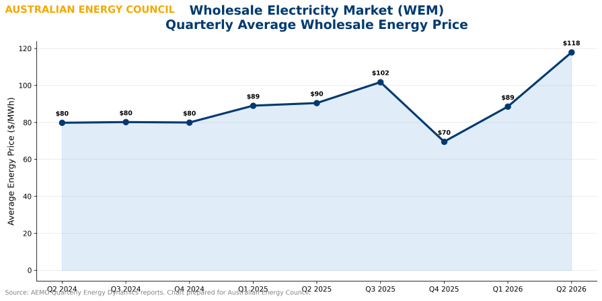
After a period of relative price stability in the WEM, there has been major volatility with the lowest and highest prices recorded within the space of three quarters.
The average WEM energy price has hovered around $80/MWh to $90/MWh between Q2 2024 and Q2 2025. Following a brief jump, prices collapsed to $69.55/MWh in Q4 2025, marking the lowest quarterly average price since the new WEM market opened in 2023. This was caused by more renewable generation at all times of the day, with renewables supplying more than 52% of total generation for the first time. Gas and coal generation both declined while battery discharge increasingly met evening peak demand.
Figure 1: Quarterly average wholesale energy price in the WEM Q2 2024- Q2 2026
The first half of 2026 illustrates just how quickly market conditions can change.
In Q1 2026, the average WEM energy price was $88.53/MWh, broadly unchanged from Q1 2025, despite renewable contribution rising from 40.8 per cent to 46.1 per cent and battery discharge rising by more than 300 per cent. The increase in battery capacity flattened the daily price profile, reduced volatility and helped displace higher-cost thermal generation.
A few months forward and Q2 2026 produced a very different outcome. Lower wind availability, reduced coal generation and increased reliance on gas-fired generation pushed the average energy price to a record $117.87/MWh, representing a 30 per cent increase on Q2 2025 and marking the highest average price in the new WEM market. This highlights how heavily the market is now influenced by weather conditions and is the first instance of significant prices changes in the WEM.
The growing cost stack
The wholesale price is an important indicator of affordability but it’s only one component of the cost stack.
The Australian Energy Market Operator’s (AEMO) Quarterly Energy Dynamics Q2 2026 report showed WEM costs as a price per MWh normalised by total energy consumed, enabling better comparison of costs between periods with different demand.
Figure 2: $/MWh costs in the WEM by market segment
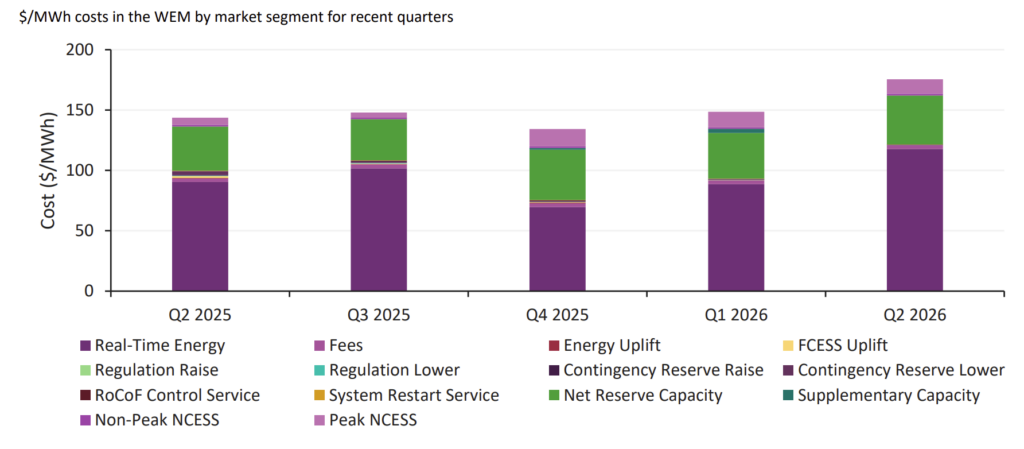
Source: AEMO QED Q2 2026
Much of the recent uplift in costs have been driven by fluctuating energy prices. But is also shows that market fees, capacity costs and system security services are often as significant as the underlying energy price itself and a major cost for end consumers.
The Reserve Capacity Mechanism remains one of the largest contributors to costs in the WEM. Normalised reserve capacity costs have increased from around $29/MWh in Q3 2024 to around $38-$40/MWh in 2025 and 2026. Much of this reflects increases in the Reserve Capacity Price (RCP) and the Benchmark Reserve Capacity Price (BRCP).
Similarly, one of the most striking cost increases has come from Non-Co-optimised Essential System Services (NCESS).
The NCESS framework allows AEMO and Western Power to procure services that are not already available through other mechanisms, including:
- services to meet power system security and reliability requirements;
- services to maintain system strength; or
- other network support services in areas where the network is unable to meet reliability expectations.
NCESS costs rose from roughly $31.7 million in Q2 2025 to approximately $65.5 million in Q2 2026 (a 94 per cent increase), making NCESS one of the fastest-growing components of the WEM cost stack.
The cost of operating the WEM is also rising. AEMO’s market fees increased from approximately $0.89/MWh in FY2022 to around $2.75/MWh by FY2026, representing a three-fold increase. Much of this growth has been attributed to the implementation of reform programs and new market systems. While AEMO’s market fees are a small part of the cost stack, it’s another layer contributing to an upward trend.
What can be done?
The energy transition in the SWIS is complex and costs will inevitably be incurred. However, some practical solutions could help to deliver the transition more efficiently.
Develop an overarching energy plan – There are currently multiple system and planning reports published for the SWIS, which creates complexity and uncertainty, and erodes investor confidence. Western Australia needs a single integrated plan linking generation, transmission, distribution and reliability to guide policy and investment priorities and boost market sentiment.
Improve transmission certainty – There are mixed signals over who is responsible for producing transmission plans. And the latest SWIS Transmission Plan focuses only on the short term and does not include critical information about transmission routes and timing. Investors need better visibility over transmission routes, timing and delivery to plan ahead. Improved coordination between generation and transmission planning would also reduce bottlenecks and reduce the need for interim reliability solutions.
Subject reforms to stronger cost-benefit analysis – The energy transition has led to a wave of reforms intended to ensure the market is able to deal with the vast amounts of new renewable and battery storage projects that are expected to connect to the grid before coal exits. Together, the reforms are ongoing, far-reaching, and complex.
To build investor confidence, undertaking and publishing cost benefit assessments or impact statements would provide a clear illustration of how proposed reforms align with other policy and market outcomes, and hopefully reduce pressure on market fees
A formal gate process requiring a transparent cost-benefit analysis before major reforms proceed would improve accountability and ensure scarce resources are directed toward the highest-value initiatives.
Reconsider aspects of the BRCP framework – The BRCP is an input of the RCP, which is intended to provide adequate price signals and deliver sufficient revenue to encourage capacity investments to ensure system reliability for electricity consumers. The BRCP has remained relatively steady for many years but it started to escalate from the 2025/26 capacity year.
Figure 3: BRCPs from the 2021/22 capacity year to 2028/29

Source: Erewa, 2026 Benchmark Reserve Capacity Prices for the 2028/29 capacity year
There were three main reasons for the BRCP increasing in the 2026 cycle:
- The Coordinator determined that a larger Battery Energy Storage System (BESS) with six hours of storage duration should be used, compared to four hours the previous year. This significantly increased capital costs.
- Material increases in labour, materials, and freight costs increased construction costs by 82 per cent.
- The introduction of a new Fixed Capital Charge of $100,000 per MW to cover costs for shared network transmission assets.
Energy Policy WA is now proposing to remove the emission threshold that will likely cause the reference technology to switch from a BESS to a gas peaker and put downward pressure on the BRCP in the next cycle. It’s a potential win for consumers who ultimately pay this cost, but it also creates mixed signals for proponents that are being encouraged to invest while facing a declining BRCP.
Conclusion
The WEM has demonstrated that increasing renewable generation and battery capacity can place meaningful downward pressure on wholesale energy prices. However, the sharp movement from record-low to record-high quarterly prices within a short period also highlights how exposed the market remains when renewable output falls and more expensive dispatchable generation is required.
But energy prices are only part of the affordability challenge. Capacity payments, essential system services, market fees and interim reliability measures are becoming increasingly important components of the overall cost stack, with these costs ultimately flowing through to consumers.
An affordable transition needs more than just new generation and storage. It requires coordinated system planning, greater certainty over transmission investment, disciplined prioritisation of reforms and transparent assessment of their cumulative costs to manage higher and more volatile costs as renewable penetration grows.
Western Australia has an opportunity to deliver a reliable, lower-emissions electricity system while maintaining affordability. Achieving that balance requires policymakers to look beyond the energy price and manage the whole cost stack.
