

Australia’s flagship emissions reduction policy, the Safeguard Mechanism, is set for review and the political jostling about what should be changed has already begun. This has included calls for the electricity sector to be added.
But at a time when cost-of-living pressures are front of mind, the Government will want to ensure the Safeguard Mechanism isn’t biting off more than it can chew.
Safeguard Mechanism in a nutshell
The Safeguard Mechanism is a baseline and credit scheme that places an emissions cap on Australia’s largest industrial facilities. Redesigned in 2022 following Labor’s election win, it captures all industrial facilities with 100,000 tCO2-e Scope 1[1] emissions or more.
These facilities receive an individual emissions baseline that declines 4.9 per cent each year and can use offsets, either Australian Carbon Credit Units (ACCUs) or Safeguard Mechanism Credits (SMCs),[2] to manage their emissions.
These reforms kicked in from 1 July 2023 and captured 219 facilities (about 30 per cent of Australia’s greenhouse gas emissions). The Federal Government decided not to capture grid-connected electricity generation facilities in the Safeguard Mechanism reforms because there were already existing policies in place “to support the ongoing decarbonisation of the electricity sector while maintaining the reliability and security of the electricity system”.[3] This is neatly illustrated in the figure below, produced in 2022.
Figure 1: Electricity sector vs. Safeguard facility emissions (BAU in 2022)

Source: Reputex
After nearly three years of operation, the Safeguard Mechanism is now underreview. This review is intended to assess whether the current design features are working as intended, as well as recalibrate the scheme to support the Federal Government’s 2035 emissions reduction target of 62 to 70 percent from 2005 levels.
One of the likely issues to emerge is whether the scheme’s coverage should be expanded. While this usually refers to adjustments to the emissions threshold (e.g. lowering the current 100,000 tCO2-e threshold to 25,000 tCO2-e), we can nonetheless expect some stakeholders to advocate for broader sectoral coverage, including the electricity sector.
Should the electricity sector be included in the Safeguard Mechanism?
When the Federal Government opted against including electricity in the 2022 Safeguard reforms, this did come with a quirk: it retained the existing emissions sectoral baseline for the electricity sector at 198 MtCO2-e per year. Why did this receive no attention? Well, because the baseline is well above the sector’s current and quickly declining emissions profile of 148 MtCO2-e.
Figure 2: Percentage change in emissions, by sector, since June 2005
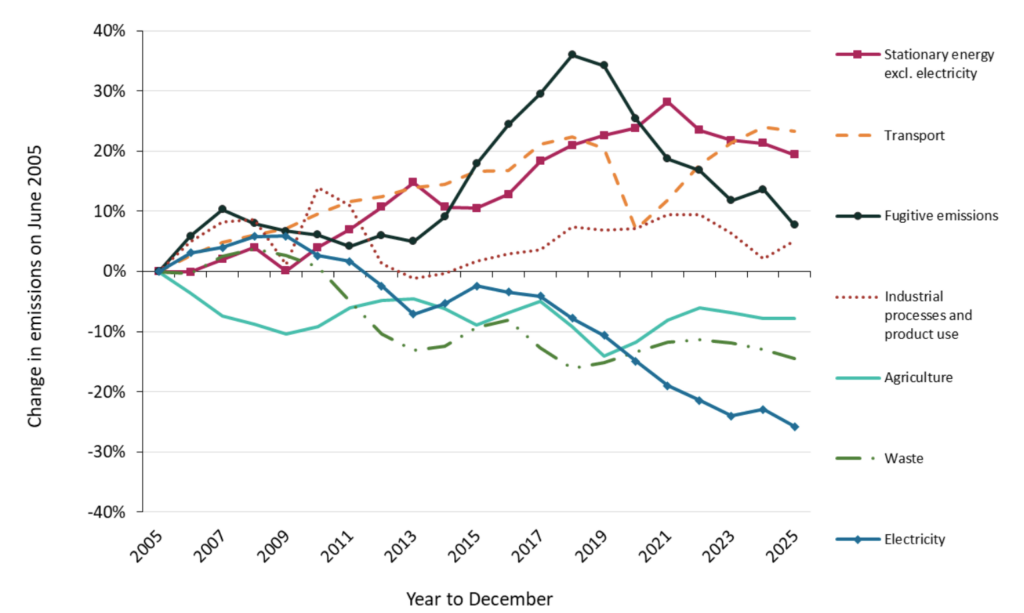
Source:DCCEEW Quarterly Update of Australia’s National Greenhouse Gas Inventory
The argument then follows that lowering this sectoral baseline below current emission levels, while placing caps on individual generators, would create incentives for the electricity sector to decarbonise faster. Furthermore, if the scheme compelled captured fossil fuel generation to purchase credits from renewable generation to offset excess emissions, this could accelerate renewable deployment.
At a surface level, the appeal of extending Safeguard coverage to the electricity sector is there. But as quite often is the case, the devil is in the detail and such a decision is not without trade-offs, namely in the form of poor efficiency and high costs. Here’s why.
1. Safeguard design not very practical for electricity
Australia’s electricity system operates in a unique environment. This is part legal and part engineering.
The legal peculiarities stem from electricity not being in the Commonwealth Constitution which means it is a de-facto state responsibility. This limits the scope of Commonwealth policies, such as the Safeguard Mechanism, as it relates to electricity. In this case:
· The Queensland Government has committed to keeping its government-owned coal fleet running until at least 2046 under its Queensland Energy Roadmap.
· While Western Australia intends to shut its government-owned coal-fired power stations by 2030, it also plans to lean heavily on government-owned gas-powered generation.
· Victoria has confidential arrangements with two of the three coal-fired power stations in its state.
Compelling these plants to participate under the Commonwealth’s Safeguard Mechanism may invite legal challenges. Alternatively, their exclusion would result in such a small pool of participating generation that it would significantly undermine the reasons for adding electricity in the first place.
The other challenge is engineering. Placing individual baselines on electricity generators is unsuited for a sector where generation output is centrally coordinated by a market operator, AEMO, to meet 24/7 demand in real time.
This could result in a range of perversities – for example, generators with below-grid average emissions intensity reducing their dispatch to stay within their individual baseline, only to be replaced by higher emitting generation. In short, electricity being an essential 24/7 service means there is no option to reduce supply below demand just to stay within a baseline.
The AEC’s Energy 2050 vision highlights the need for thermal exit pathways to be orderly to ensure there are reliable investment signals and lower wholesale prices.
2. Uncertainty about cost impacts
The Grattan Institute published a report in October last year making a case for electricity’s inclusion into the Safeguard. It provided modelling about cost impacts that said household electricity bills would increase by $70 per year on average. But this came with the qualifier that rapid electrification would cut future household energy bills in half to make such an increase insignificant.
The vagaries of economic modelling make it hard to assess such claims. Where these arguments become difficult is the assumption that coal-fired plants will naturally close once uneconomic. As explained already, the legal and political setup of electricity generation means some state governments have committed to maintaining coal in the system no matter the economics.
This is because government’s first responsibility is to keep the lights on, so generators can only close once state governments and the energy operator are confident reliability and system security will not be compromised.
In the case of reliability, this means building sufficient new renewable generation and storage to replace coal’s output. While economic incentives are one part of this, there are many supply-side constraints like environmental planning and social licence currently slowing down renewable deployment. Adding electricity into the Safeguard will not resolve these constraints but it will increase the costs of running the current generation mix in the meantime.
System security is where things become even trickier. A main reason for extending Eraring Power Station in New South Wales is to manage risks to system security identified in AEMO’s Transition Plan for System Security. Variable renewable generation does not provide the equivalent essential services of thermal plants, and alternatives (e.g. procurement of synchronous condensers) are progressing behind schedule.
The AEC, alongside the Clean Energy Council, have submitted a rule change designed to improve deployment of essential system security services to help resolve this transition roadblock.
This rule change aims to further the AEC’s Energy 2050 vision for essential system services to be procured competitively and at lower cost.
3. Improving, rather than confusing, the existing suite of policies
As the Federal Government has articulated previously, there are existing federal and state policy mechanisms in place to drive emissions reductions in the electricity sector, as well as a sophisticated roadmap to net-zero through AEMO’s Integrated System Plan. The absence of decarbonisation policies in other sectors is what initially triggered the Safeguard reforms, as explained earlier.
Since 2022, additional policies have been announced to continue driving down electricity sector emissions. Most significantly, there has been the National Electricity Market (NEM) Wholesale Market Settings Review which had as its purpose to set up enduring mechanisms to promote investment in firmed, renewable generation and storage capacity. Its primary outcome, the Electricity Services Entry Mechanism (ESEM), is currently in the design phase and intends to create a liquid forward price curve that accelerates investment in new renewable generation.
Having fundamental, parallel reforms to the energy market would create regulatory confusion about whether they complement each other, as well as resourcing strains that slow their implementation.
4. Maintaining incentives for gas-powered generation
Consistent with the AEC’s Energy 2050 vision, AEMO’s 2026 Integrated System Plan reinforces the critical role that gas-powered generation will play through the energy transition: the NEM is projected to need 17 GW of flexible gas-powered generation by 2050 to ensure resilience under a range of power system conditions and weather events.[4]
Despite the lucidity of AEMO’s message, conditions for investment in gas-powered generation are difficult and uncertain, primarily due to the volatile political environment of energy policy. Being covered by the Safeguard would not help the investment case and could create significant hesitation about how a gas-powered generator operates during peak periods without exceeding its cap.
Looking ahead
As the Federal Government looks ahead to its 2035 target, there will be robust policy debate about the best way to get there. Electricity is already on a trajectory to be one of the lowest emitting sectors by 2035,[5] and is expected to play a substantial role in helping other sectors decarbonise, whether that be through supporting electric vehicle uptake or providing Safeguard facilities with onsite abatement options via electrification.
