
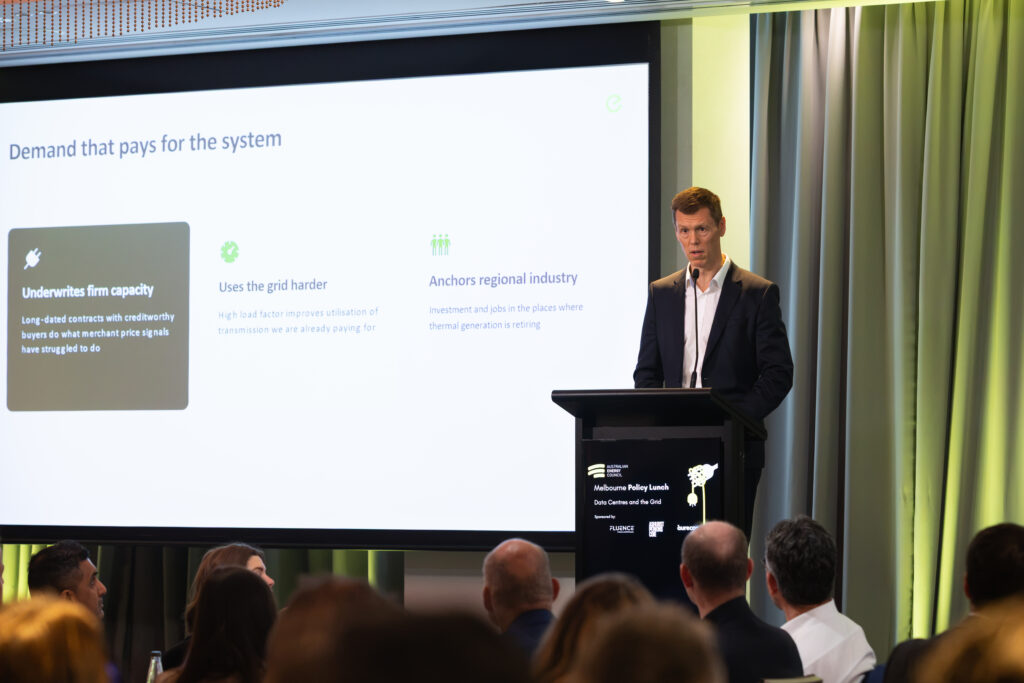
Mark Collette, Managing Director, EnergyAustralia, gives the keynote address
Australia’s data centre boom is here, putting questions about how to best connect them, power them and pay for the infrastructure they need firmly on the energy policy agenda.
Data centres are expected to drive substantial electricity demand growth over the next decade, reshaping generation investment, network planning and infrastructure development. In NSW alone, Transgrid now expects data centres to account for around two-thirds of electricity demand growth by 2035 – four times higher than projected just one year ago.
Those themes were front and centre at the Australian Energy Council’s Data Centres and the Grid Policy Lunch in Melbourne, where leaders from across the energy, infrastructure, technology and government sectors explored what is rapidly becoming one of the defining energy policy issues of the transition.
The keynote address from Mark Collette, Managing Director of EnergyAustralia, focused on the scale of the opportunity facing Australia.
“Over the past 20 years electricity grid demand has fallen. Now it’s growing. Fast. That’s a good problem for the industry to have,” Mr Collette said.
Drawing a parallel with aluminium smelters that historically shaped Australia’s electricity system, he described data centres as the “smelters of the modern age”. At gigawatt scale, data centres are no longer simply another customer connecting to the grid. They are large enough to influence how generation and transmission infrastructure are planned and financed.
As artificial intelligence, cloud computing and digital services continue to expand, the energy sector increasingly needs to think about data centres as part of the system, not just connected to it.
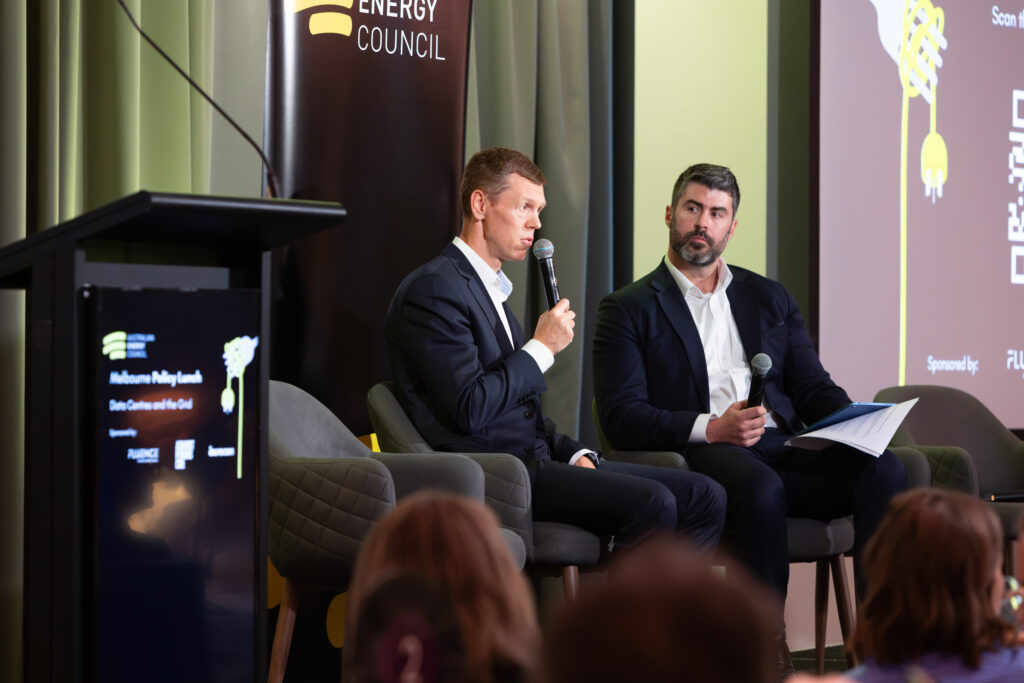
Mark Collette, Managing Director, EnergyAustralia and Ben Barnes, General Manager Corporate Affairs, Australian Energy Council
A central theme of the keynote was that Australia’s retiring coal-fired power station sites offer a unique competitive advantage in attracting global data centre investment.
According to Collette, many of the attributes sought by hyperscale data centres already exist at former coal generation sites.
“Write down everything a big data centre needs. Grid connection, water, industrial land, people who know how to run heavy plant, communities that understand industry. Now write down what a coal-fired power station already has. Same list,” Mr Collette said.
Using EnergyAustralia’s Yallourn site as an example, he said these assets could significantly reduce development timelines and represent a genuine competitive advantage for Australia.
“The sites are ready. Coal power station sites can connect big data centres within a couple of years. Start greenfield from a paddock and you’re most of a decade,” Mr Collette said.
“I’ve talked before about coal checking out. Now we have the opportunity for a new industry to check in.”
While the keynote focused on opportunity, the panel discussion quickly moved to the practical realities of integrating data centres into an electricity system already undergoing unprecedented change.
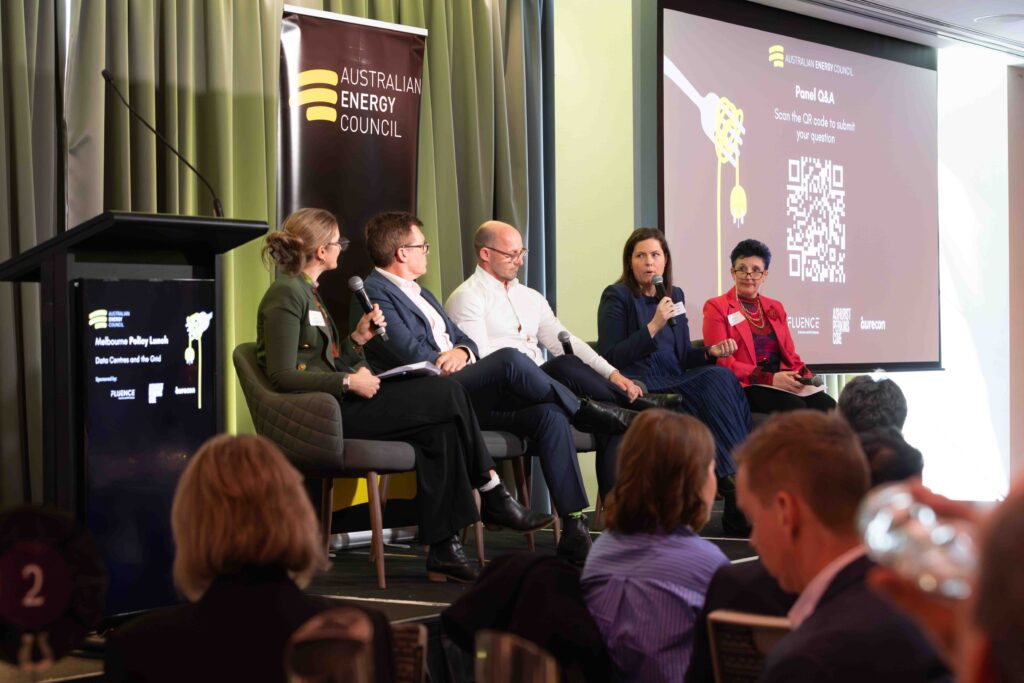
Cross-industry panel discussion: Facilitator: Kate Muller, Ashurst Perkins Coie, Panellists: Paul Gleeson, Aurecon, Paul Grzinic, Firmus Technologies, Laura Caspari, ENGIE ANZ, Elizabeth Molyneux, DEECA
One of the strongest themes to emerge was that data centres should not be treated as a single category of customer.
As Paul Grzinic from Firmus explained, traditional data centres, hyperscale facilities and AI factories can have very different operating models, demand profiles, flexibility characteristics and location requirements. Some may be capable of adjusting workloads and participating in demand response programs, while others require near-continuous operation and proximity to users or data. The implication is clear: one-size-fits-all policy settings are unlikely to succeed.
The discussion also challenged perceptions that large data centres are inherently inflexible. Some AI-focused facilities may be able to adjust workloads or reduce consumption during periods of system stress, potentially allowing them to become active participants in managing reliability rather than simply an additional source of demand.
The panel repeatedly returned to what many participants described as the central challenge facing policymakers: timing.
Data centres can often be developed and connected more quickly than transmission lines, wind farms and other large-scale infrastructure projects can be delivered. While the long-term shape of the system may be reasonably clear, managing the transition period between today’s infrastructure base and tomorrow’s is proving more complex.
An area of agreement across all speakers was that data centres should not be viewed solely as a challenge for the electricity system.
Elizabeth Molyneux, Deputy Secretary Energy at Victoria’s Department of Energy, Environment and Climate Action, noted that data centres represent both an economic opportunity and one of the few emerging customer classes capable of supporting the long-term contracting needed to bring forward new generation investment.
Rather than simply increasing demand, data centres have the potential to help underwrite the infrastructure needed to support that demand.
The AEC sees this as particularly important for wind and storage projects that need revenue certainty to proceed.
Despite the optimism, panel discussions frequently returned to customer outcomes.
New demand can improve utilisation of existing infrastructure, strengthen investment signals and help unlock new investment. However, there was also broad recognition that affordability and reliability for households and businesses remain paramount.
A recurring theme was the need to ensure new demand pays its way, rather than leaving existing customers to fund the infrastructure required to support it. While methodologies and mechanisms are still being worked through, there was broad support for the principle that costs should be allocated fairly and transparently.
As highlighted by Laura Caspari, CEO & Managing Director, Renewables & Batteries at ENGIE,a key consideration for any requirement on data centre operators to bring their own new and additional generation was navigating the supply-demand balance to ensure consumer bills stay as low as possible as the transition plays out.
Paul Gleeson, Aurecon Managing Director Energy, said by bringing such large loads to the grid, data centres had become a central part of how the energy system operates. He said proponents need to embrace this and accept the sector’s slower processes and technical requirements to earn social licence with communities and capture the benefits of data centre growth by driving
economic development.
“By complying with all those requirements to keep you in a reasonable band of wholesale prices and a reasonable band of system reliability, that’s a much better likelihood of massive data centre
rollout without resistance and pushback,” Mr Gleeson said.
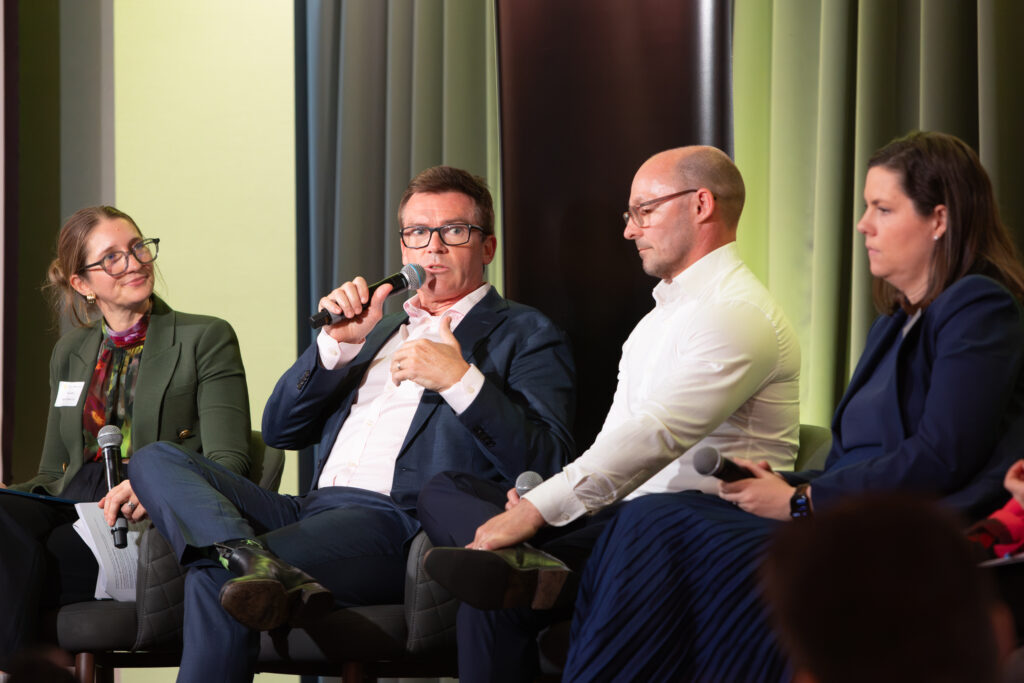 Paul Gleeson, Aurecon, speaks during the cross-industry panel discussion
For all the discussion about policy design, infrastructure planning and market reform, Mr Collette concluded with a simple observation.
Australia is competing for globally mobile capital.
“This capital is mobile. It can go to Malaysia, or Japan, or the United States, and it moves on the timeframes those investors work to, not ours,” Mr Collette said.
When asked what would ultimately determine Australia’s success, his answer was concise: “Execution.”
The opportunity is clear. The challenge now is ensuring new demand is matched by new supply, costs are allocated fairly, and investment is translated into the generation, storage and infrastructure needed to support Australia’s next wave of economic growth.
The AEC extends its thanks to keynote speaker Mark Collette, moderator Kate Muller, panellists Elizabeth Molyneux, Laura Caspari, Paul Gleeson and Paul Grzinic, and to event sponsors Fluence, Ashurst Perkins Coie and Aurecon for helping make the discussion possible.
The conversation will continue at our future events, including the AEC Conference 2027, to be held on 25 May 2027 at The Ritz-Carlton Melbourne.
Organisations interested in staying connected to the policy debates, market developments and industry leaders shaping Australia’s energy future are encouraged to explore AEC Associate Membership. Opportunities are also available to partner with the AEC through our events and sponsorship program, which brings together senior decision-makers from across the sector to examine the issues driving market transformation.
