
Australia needs more electric vehicle charging infrastructure. The more difficult questions are where it should be built, who should own it and who should pay.
Those questions sit at the centre of the Australian Energy Market Commission’s (AEMC) draft determination on a rule change to facilitate the Commonwealth’s Accelerating Electric Vehicle Charging Program. The program targets regional charging blackspots and metropolitan areas where off-street charging is limited.
The draft rule would allow participating distribution network service providers (DNSPs) to help deliver the program and recover part of its cost through regulated network charges, which are paid by consumers. The AEMC considers the benefits are likely to outweigh the costs because the program is targeted, time limited and gives private providers the first opportunity to invest in metropolitan kerbside sites. For consumers grappling with high energy prices in a cost-of-living crisis, even incremental increases to network costs can entrench affordability concerns.
The key question is whether this is a chicken and egg problem that needs to be solved now, or whether the competitive sector can achieve the desired outcome at a lower cost to consumers. We take a look.
What is being proposed?
The Commonwealth program aims to support an estimated 14,000 chargers by 2029. Its design differs between metropolitan kerbside charging and regional blackspots.
For metropolitan kerbside sites, DNSPs would identify locations and private charge point operators would have first right of refusal. If none takes up a site, the DNSP would install a slower AC charger as provider of last resort and appoint a commercial provider to deliver charging services.
For regional blackspots, successful DNSP bidders would install faster DC chargers and appoint a commercial provider to supply charging services.
The Commonwealth would contribute around 30 per cent of eligible infrastructure costs. Participating DNSPs would recover the remaining approved costs from electricity consumers through regulated charges. The AEMC estimates this would add around $1 a year to a typical residential bill for five years.
What has the AEMC decided?
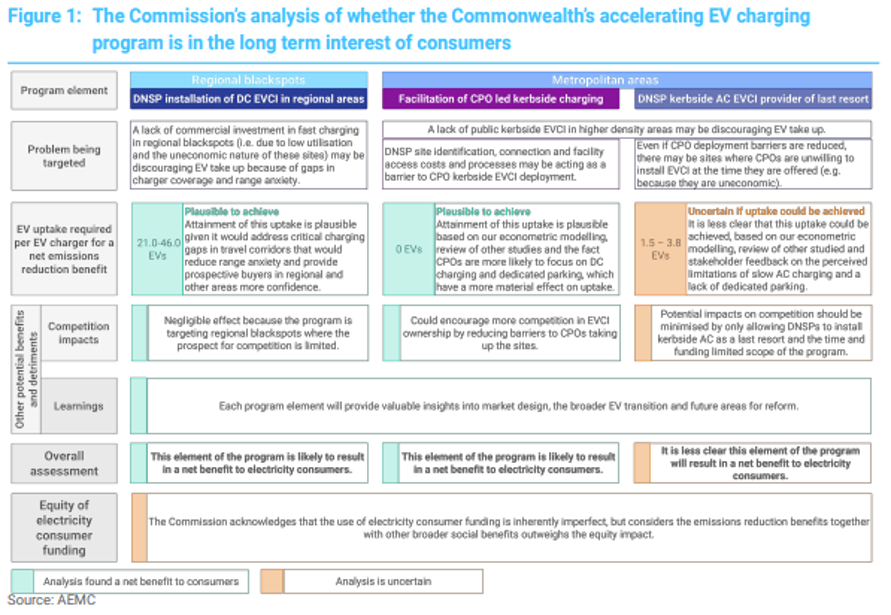
The Commission assessed three elements separately: DNSP-delivered regional DC charging; metropolitan kerbside sites taken up by private operators; and metropolitan AC chargers installed by DNSPs as provider of last resort. It found the first two likely to deliver net benefits, but acknowledged greater uncertainty around the third.
In assessing the benefits case, the AEMC’s breakeven analysis only puts a dollar value on transport emissions reductions and compares that with the costs that will be recovered from electricity consumers. Its overall assessment framework is broader, also considering potential benefits such as lower transport costs for people who switch to EVs, improved access and convenience, more efficient network use, reduced barriers for private charging investment and the value of information generated by the program. Most of these benefits are considered qualitatively rather than included in the breakeven figures.
For regional blackspots, the AEMC sees a strong case for intervention: gaps in fast-charging coverage can constrain travel and confidence in EV ownership. It estimates that each charger would need to lead to 21 to 46 additional EV purchases over its life for the value of the resulting transport emissions reductions to exceed the costs recovered from electricity consumers. The AEMC considers that threshold is likely to be met because filling regional charging gaps could materially improve confidence in longer-distance EV travel.
Private operator-led kerbside charging is more straightforward. Operators would fund their chargers, while the program would address barriers such as site identification, connection processes and pole access. The AEMC considers this could accelerate investment at little or no net cost to electricity consumers.
The more difficult question is DNSPs’ provider-of-last-resort role in metropolitan areas. Each network-owned AC charger would need to induce 1.5 to 3.8 additional EVs over its life to break even. The AEMC cannot conclude that threshold will be met, particularly for slower chargers without dedicated parking.
Assessments of proposals such as this against the National Electricity Objective (NEO) are difficult at the best of times, but in this instance the assessment requires assumptions to be made about consumer behaviours in the transport industry absent the policy. Compounding the complexity, in the months since the start of the conflict in the middle east, EV numbers in Australia have been skyrocketing absent any policy interventions. The AEMC highlights its approach in the table below, noting in several areas its own analysis is uncertain.
Is more evidence required?
Although the program is described as targeted and temporary, the rule would shift the boundary between regulated network activities and a developing competitive market. The detail therefore matters. This week, a cohort of industry players including the AEC wrote to the AEMC highlighting concerns with the draft proposal, in particular the risk to the development of a competitive charging industry in Australia, and higher customer bills.
The group argues that there is insufficient evidence that the draft decision is likely to advance the NEO, given the lack of reliable estimates of charger use and additional EV uptake required to achieve the emissions reductions assumed.
Secondly, they note that a private operator declining a site does not necessarily establish lasting market failure. It may reflect location, expected use, parking, connection costs or timing. Before consumers fund a network-owned charger, there should be confidence that the site is genuinely unlikely to be served competitively and that network delivery is the most efficient response.
Thirdly, the letter notes that cost recovery deserves scrutiny. The AEMC’s draft determination caps recoverable costs and limits recovery to delivered sites, but the Australian Energy Regulator (AER) would not assess successful bids upfront. Instead, the AEMC relies on competition between DNSPs for Commonwealth funding to reveal efficient costs.
What happens next?
There are barriers to delivering the charging infrastructure that Australia will need, and there is an opportunity to improve the information flows between networks and industry. Faster connections, transparent network capacity information, suitable sites and reasonable access arrangements can help competitive providers invest sooner and at lower cost. These issues all need to be improved to see faster rollouts of the EV chargers motorists want.
Australia needs charging that supports regional travel, gives people without off-street parking a pathway to EV ownership and keeps pace with the transport transition. It also needs to protect electricity consumers and maintain confidence for the private investment that will deliver most of the network.
The draft determination is an attempt to balance those objectives, and its narrower, capped approach improves on the original proposal. But uncertainty, in particular around DNSP-owned metropolitan charging means the final decision needs clear evidence, strong consumer safeguards and careful consideration of less intrusive alternatives.
The AEC will examine these issues in its formal submission. For now, the key point is that supporting EV charging and supporting competition are not mutually exclusive. The AEMC must ensure the final rule gets that balance right.