

The Australian Government describes a 10 per cent mandatory gas surplus under its proposed Domestic Gas Reservation Scheme as a “modest margin”. But at around 50 petajoules, it is anything but small, and raises a bigger question: where would all that extra gas actually go?
While extra supply may put downward pressure on prices in the short term, forcing too much gas into the domestic market could dampen investment signals, crowd out domestic producers and create new risks for electricity markets.
So is 10 per cent genuinely modest, or could a smaller margin better balance near-term security with long-term market stability? We take a closer look.
The economics of an oversupply
In most markets, oversupply is temporary. Prices fall, production slows and the market gradually returns to balance.
Where it gets complicated is when an oversupply is policy driven, production decisions are made years in advance, and/or the product cannot be easily stored. The current conjecture about a gas oversupply represents all three elements:
- The federal government is mandating an oversupply;
- The total supply of gas is based on investment decisions made years prior; and
- Options for the storage of excess gas are limited.
The attraction of a surplus is clear: more gas available domestically may place downward pressure on prices. But if short-term lower prices was the only objective, there would be little reason to stop at 10 per cent.
The real challenge is balancing affordability today against the investment signals needed to secure tomorrow’s supply, so Australia has long-term gas security. Hence the Australian Government has proposed a 10 per cent oversupply as a “modest margin” that seeks to balance these competing policy objectives.
What does a 10 per cent oversupply look like?
As there are different estimates of the total supply of Australia’s domestic east coast gas market, stakeholders have placed a 10 per cent oversupply generally in the range of 45 PJs to 50 PJs.
To try to conceptualise just how much energy that represents, the starting point is that a “joule” is the standard unit of energy and one joule is the equivalent of one watt of power radiated.
The scale of joule use is:
- Megajoule (MJs): Equal to 1 million joules. This amount of energy can power small everyday tasks or heat a small amount of water.
- Terajoule (TJs): Equal to 1 trillion joules. This is used for large energy systems, like the power used by a small town over time.
- Petajoule (PJs): Equal to 1 quadrillion joules. This unit is used for statewide, national, or global energy statistics and wholesale markets.
The graph below gives an indication of how much energy everyday applications use.
Figure 1: Understanding the megajoule: A measure of energy in natural gas
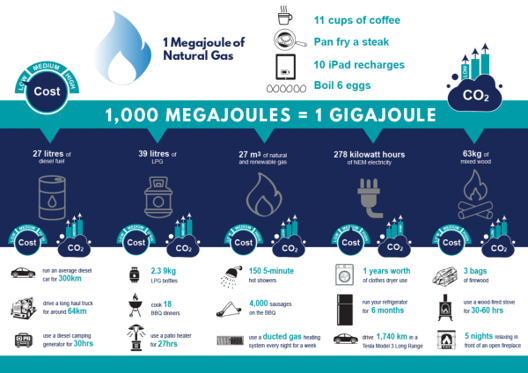
Source: Australian Pipelines and Gas Association (APGA), Fact Sheet
DCCEEW’s latest Australia Energy Statistics state that “one petajoule, or 278 gigawatt hours, is the heat energy content of about 43,000 tonnes of black coal or 29 million litres of petrol. One petajoule is equivalent to filling up a car with a fuel tank capacity of 55 litres of petrol around 532,000 times. A car using 6 litres of petrol per hundred kilometres could drive approximately 483 million kilometres on one petajoule, more than three times the distance from the Sun to the Earth”.
Where would all this excess gas go?
A primary reason for an oversupply provision is to manage forecasted gas shortfalls in the southern states, particularly in Victoria. Whether an oversupply of nearly 50 PJs is needed is up for debate. A 10 per cent surplus translates to roughly 45-50 PJ of additional gas entering the domestic market. To put that figure into context:
- It’s roughly equivalent to the annual industrial gas consumption of Victoria.
- It is around twice the maximum storage capacity of the Iona Gas Storage Facility which the Australian Competition and Consumer Commission says has ‘central importance in meeting southern state gas needs’.
The key point is not the unit conversion. It is that 50 PJ is a substantial volume of energy that would need to be stored, transported or consumed somewhere within the domestic market.
Queensland has larger storage assets, but there are physical constraints to transporting gas south during imminent shortfalls. The Australian Energy Market Operator has noted that even with anticipated investment in transport and supply, it is ‘not yet sufficient to replace declining southern production or meet winter peak day demands of similar magnitude to historical peaks’.
Figure 2: Storage, withdrawal, and injection capacity, by facility
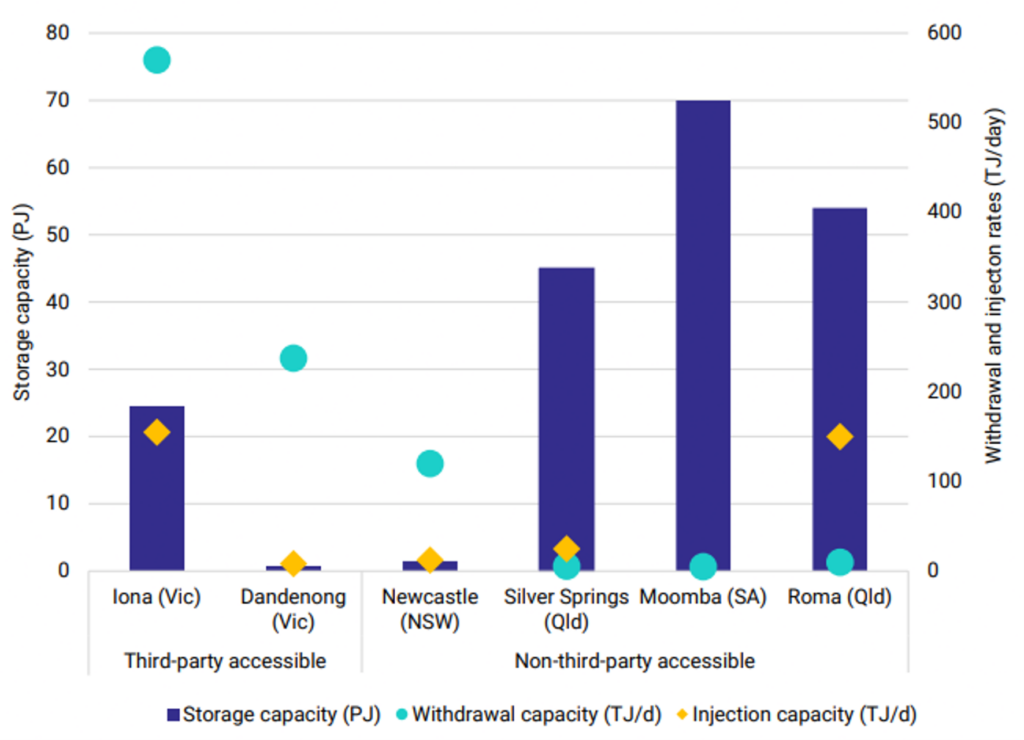
Source: ACCC, Gas Inquiry 2017-2030, p36.
If the surplus cannot be stored and cannot be exported, it must ultimately be absorbed by the domestic gas market.
That creates a risk that gas could be sold at heavily discounted prices simply to satisfy compliance requirements rather than genuine market need. This is unlikely to deliver long-term energy security to Australia and Australian businesses. Instead, it could result in:
- Dampened investment signals – this will reduce the ability to maintain long-term supply adequacy. The ACCC has said that ‘there will need to be ongoing investment in gas production by both LNG exporters and domestic producers’ to prevent future shortfalls.
- Crowding out of domestic producers – it will become harder for domestic buyers to contract on durable terms, and increased competition for access to storage may become cost prohibitive.
- Disruption to electricity markets – increased use of gas-powered generation to absorb excess gas could disrupt investment signals for renewable generation and storage.
For these reasons, the AEC argues that a 10 per cent margin is material rather than modest.
What would a modest margin look like?
There is no optimal level of mandated oversupply. The appropriate margin should ultimately reflect market conditions, storage capacity and emerging supply risks. The Exposure Draft does allow for ministerial discretion to lower the oversupply level, although it is not clear what might trigger its use.
The AEC has suggested that an upper limit of 5 per cent (about 25 PJs) would theoretically be enough to ensure Iona maintains near maximum storage capacity in winter months, which may be a loose benchmark for the level of oversupply that can be absorbed to manage southern shortfalls and minimise impacts to the domestic market.
The policy objective should be to deliver the minimum surplus necessary to maintain energy security while preserving incentives for future investment.
